Sunday, August 7, 2016

Who Does He Say Who You Are: Women Transformed by Christ in the Gospels by Colleen C. Mitchell


How do we define ourselves or more importantly who defines us? We might say we define ourselves but shouldn’t we be looking to God about who we should be.  The author states in the prologue, “ I began to remember God’s vision for who I am, to hear him remind me of who it was he made me to be, by drawing near to him in prayer and reading scriptures, which had always been my favorite way to encounter Jesus and build my relationship with him”. The title “Who Does He Say You Are” is of course a play on words from the Gospel of Mark 8:29. “Jesus asked. “Who do you say I am?” Peter answered, “You are the Messiah”. The author, Colleen Mitchell shares with us her personal story of loss and grief as the backdrop of her book.  She brings us along on her spiritual journey.  She includes, “And somehow we found our way through the grief and I found my way back to intimate friendship with Christ, back to who he says that I really am”. 
I liked that the bible verses were provided not simply their bible reference pages at the beginning of each chapter. Description of the women in the New Testament like the Virgin Mary, the Samaritan woman at the well, Mary Magdalene, and Mary and Martha to name a few, are the topics of the chapters.  A feminine spirituality is explored by the author and is also consistent with Catholic teachings. The best part is her confrontational style of addressing us her readers. You can see yourself in the characteristics of each woman’s story in the bible. The author draws us out with questions and reflections. I loved the prayers at the end of each chapter. The author concludes with, “I hope you are encouraged to see the Gospels as an invitation to consider who we are in light of who Christ is and to accept the grace he offers us to be transformed by our encounters with him”.
I would recommend this book to you because it accomplished its purpose in drawing me closer to God. In times of grief we can feel lost and this book makes you feel found again.

Wednesday, July 27, 2016

Men, Women and the Mystery of Love: Practical Insights from John Paul II’s Love and Responsibility By Edward Sri

We think as a society we cannot define love. But I would say to you Saint John Paul the II did just that with his writings in Love and Responsibility and later in his Theology of the Body. The author, Edward Sri, does a wonderful job of unpacking a complicated topic for us the readers. Real love he explains is not just the "butterflies in your stomach" when you first date the love of your life but what you feel after 60 years of marriage. But this book not only delves into marital love but love in all aspects like friendships and family. “Love is a virtue that involves sacrifice, responsibility and total commitment to the other person. Hollywood love is an emotion” says Edward Sri.
My favorite example that brings it all together is the reference to the movie Titanic. In the movie many people glorify the emotional romance between the two main characters. “Two people whose romance develops over just a few days, which don’t really know each other and have no true commitment to each other.” says Edward Sri.  Is this our ideal kind of love? John Paul the II explains that when we are carried away by our emotions, sentimentality may hinder our ability to know that person as she or he really is. Mr. Sri asks "Is this the kind of person who will make sacrifices for me and put what’s best for me or our family before them?" The Catechism defines love as willing the good of the other.
Original sin is explained as when “Shame” entered the world. “Shame involves fear of another person, the sense that we’re not sure we can trust that person. We fear being used or being hurt, so we are afraid of being vulnerable in letting others see us as we really are.” Matthew Kelly wrote: “We can’t be loved for who we are if we won’t reveal ourselves. Unrevealed we never experience intimacy.” The more the Holy Spirit transforms our selfish and lustful hearts with the total self-giving love of Jesus Christ, the more relationships will recover their original meaning that God designed for us in the Garden of Eden.
I would recommend this book to you and for those we love who are living in difficult relationships. It would be a great gift to our young teens trying to make sense of dating and beginning relationships with the opposite sex. I found myself in many ways within the pages of this book. It is about healing and raising up the value of tr

Monday, January 18, 2016

City of Saints: A Pilgrimage to John Paul Il's Krakow by George Weigel

Against a prequel background to World Youth Day 2016 by a renowned author George Weigel is set the biography of a great saint. I learned so much about St. John Paul the II and I had not read anything about his life story before this book. The black and white photos are amazing surpassed only by the color photos in the center of the book taken by George Weigel's son, Stephen Weigel, while Carrie Gress has provided historical notes.
The book has an unusual format that is linked to maps and history with a personal story as a guide. City of Saints makes me want to visit Poland and see the sites mentioned in the book. The reader can better understand where St John Paul got his ideas of freedom from after being forged in Poland during World War II. I never thought of Poland as a beautiful place or as a vacation destination. But now I know so much more about the history of Poland and its link to saints such as Sister Maria Faustina Kowalska. Pope John Paul the II canonized her in the Jubilee year of 2000. He was responsible for the feast of Divine Mercy Sunday. He knew there was much healing needed in the world after World War II and the assaults to human dignity that were perpetrated. George Weigel tells us in City of Saints that "John Paul the II's response to the mystery of evil was to embrace the cross of Christ as a priest of the Catholic Church, spending out his life in defense of the dignity of others."
I would recommend City of Saints for you to discover the life story of St John Paul II, which is inspirational and this book takes you on a journey worth taking through the contemporary history of the  Catholic Church. I did know John Paul was an active outdoor person that liked skiing and kayaking but I did not know he was an actor. He used his acting during World War II before becoming a priest to help continue the Polish culture that the Third Reich was trying to extinguish. He was Archbishop of Krakow and his best accomplishment to me is his Theology of the Body. This theological document is rich in the dignity of the human person and what true love looks like between humans and between humans and God.
City of Saints would make a great travel guide of Poland at anytime and is perfect for the upcoming World Youth Day in 2016. I would recommend reading it before you visit Poland, studying the maps included and making a travel plan according to the book of sites to see.

Sunday, January 10, 2016

My Badass Book of Saints: Courageous Women Who Showed Me How to Live by Maria Morera Johnson

The Saints are true models of how how to live faith filled lives. My Badass book of Saints brings their stories out of the clouds and shines a light on their true life stories. I have always liked reading about the saints but I loved the format of this book. First there is a personal story from the author, then a story from a contemporary cultural icon, then a tie in with a saint story and a rap up at the end to connect the three stories. This format makes the saints more approachable and relatable. Some of the saints included are: St. Joan of Arc, St. Teresa of Avila and St. Rose of Lima, just to name a few. Each chapter has a theme such as selflessness or perseverance and there are questions to ponder at the end of each chapter. This makes it perfect for discussion and group reading.
I like how Maria Johnson teaches us how this all applies to our daily life with her quote "All of us are called to do our best . These ....don’t inspire me to go out and look for opportunities to do good. Rather, they inspire me to keep a more watchful eye within my own circles of influence to see what needs to be done there, especially with my family, friends, and people with whom I interact." I know I can often be looking for a project in the community at large,  instead of looking inside my life already for opportunities to do good.
I would recommend this book to you as a fun way to get to know some remarkable women to inspire you. I liked being challenged to think of women in our own lives that are courageous and compassionate as some of the themes and questions suggest. The title is great and I love the description of bodacious women we can not just imitate but find their qualities in ourselves already, waiting to be tapped into to bring more to our lives and those around us.

Saturday, January 9, 2016

The St. Teresa of Avila Prayer Book by Virginia Hampton Wright

St Teresa of Avila is a doctor of the Catholic church now but I learned she was controversial in her day. Her contemplative connection with God was looked on with skepticism in her day. The author seems to know St Teresa like a family member. You can tell she did her research. The first part of the book is biographical but fun, not dry. St Teresa's prayers in her own words are beautiful. The most distinguishing feature of this book is the alignment of St  Teresa's prayers with a liturgy of the hours type format with morning and evening prayers.
St. Teresa had a hard time with formatted prayer and sought a more personal relationship with God. She felt herself drawn to God's presence without even trying. She naturally tended to contemplative prayer but she also studied about it in the book by Francisco of Osuna called the Third Spiritual Alphabet. Her marked up and worn copy is still available to view today. One of her students became known as St. John of the Cross.
I love the description of prayer straight from St. Teresa, "She described prayer as different ways of watering a garden. Sometimes we must draw water up from the well, which requires much effort on our part, and other times we simply direct the water to where it needs to go; and then sometimes the water arrives as rainfall and we don’t have to do anything but enjoy it."
Virginia Wright helps us to see and pray with St. Teresa stating, "Ultimately, what St. Teresa of Avila brings to us is confidence in God’s great mercy toward us and God’s willingness to meet us in our flawed humanity and dwell with us right here and now."
I would recommend this book to you to understand St. Teresa of Avila better and deepen your prayer life. The author makes St. Teresa approachable, understandable and a prayer partner which is definitely a plus. I like that there are themes and structure provided for prayer and inspiration from St. Teresa of Avila.

Tuesday, January 5, 2016

Pray Like a Gourmet: Creative Ways to Feed Your Soul by David Brazzeal

Prayer is relationship. It is important to spend time enhancing our relationship with God. We can get in a rut in any relationship and can need a refresh. Pray like a Gourmet is definitely refreshing. I was initially concerned about the association with food. If you think about it though, food is one of our basic needs like love and relationship, so we can all relate easily to this analogy. I like the mix of traditional and creative prayers with a simple or complex mode according to your wants and needs in your prayer life. You can literally use your whole self; mind, body and spirit and all your gifts and talents as a gift to God in prayer.
One of my favorite parts of the book is the analogy in the introduction about a meal in France versus American fast food and our prayer life. Mr. Brazzeal teaches how to savor our time with God and give him the best of ourselves and also that we can be real with God. The format of the book is interesting, such as part two which describes types of prayers, with biblical references and lots of examples. Types of prayers discussed are: Adoration, Confession, Thanksgiving, Petition, Observation, Intercession, Meditation, Contemplation, Blessing, Lamenting, and Joining.  There are Catholic undertones and sometimes it is even more explicit with confession and saints, etc. One thing I did not like is that the words of importance that are supposed to summarize and stick out to you are in light yellow print. I think a bold darker color would have been more effective but it did cause me to have to look closely.
The author makes his home in France, has lived in Brazil, and has worked in Guadalupe and Quebec. The description in his biography includes "all his work is inspired by the organic fusion that exists between the spiritual and the creative". In chapter two, Brazzeal tells us "Several religions practice specific food restrictions and fasting as spiritual reminders.." Also that, "Abstaining from physical food can play a powerful role in creating a hunger and receptivity for spiritual food.." There is a lot of food analogies in organized religions and specifically Catholicism in the Eucharist.
I would recommend this book to you to enhance your prayer life. The book is very visually appealing with tons of prayer ideas. You can take your time reading the book as you try all the great suggestions. Let yourself be challenged as you grow spiritually and closer to God.

Sunday, December 20, 2015

The Passion and the Cross by Ronald Rolheiser

The crucifixion is the other side of the coin of the nativity. As we approach Christmas through the doors of advent we see the love of God through the incarnation. Both the incarnation and the crucifixion show not just how much God loves us but they also show us how to love each other. The first chapter explains about the passivity of Jesus and how all during the crucifixion Jesus was not only passive about resisting but showed great love to his tormentors. Jesus demonstrated how to turn anger, hate and hurt into peace, love and health. Subsequent chapters unpack the mystery of the cross and Jesus as redeemer not rescuer. God did not promise we would not suffer but showed us how to turn bad into good. Christ redeems our suffering and gives it meaning. Rolheiser states, "the love that Christ reveals in the cross is so strong that it can descend into any hell we can create, thaw out our frozen souls, and lead us into the light and peace of paradise, despite our fears and weaknesses."
True love is sacrificial. In The Passion and the Cross, "This is what constitutes the sacrificial part of his love; namely, the excruciatingly pain (ex cruce, from “the cross”) that he had to undergo in order to take in hatred and give back love. But that is the only way that sin can ever leave a community; someone has to take it in, hold it, carry it, and, through a certain excruciating sacrifice of self, transform it into something else." Love is relational and transformative. We see this in the baby Jesus, stated by Rolheiser as "But God’s power is the power of exousia— a baby that lays helpless, muted, patient, beckoning for someone to take care of it. It’s this power that lies at the deepest base of things and will, in the end, gently, have the final say. It’s also the only power upon which love and community can be created because it, and it alone, ultimately softens rather than breaks the heart.
It is important while standing at the manger at Christmas we remember the standing at the cross that will be forthcoming at Easter. This completes the love story of Incarnation, Crucifixion and Resurrection. I would recommend this book to you to bring forth ideas I had not otherwise been exposed to in theology and exposition of the love of God. Why did Jesus have to be crucified? How are we redeemed? The Passion and the Cross brings the answers into focus.

Wednesday, December 2, 2015

Strange Glory: A Life of Dietrich Bonhoeffer by Charles Marsh


One of the greatest theologians of our time, Dietrich Bonhoeffer was a complex man of contradictions. The author, Mr. Marsh peels back every layer so we can see the whole picture of a man obviously enamored of Catholicism but who never converted. He remained a protestant preacher although highly intellectual and he spent a life time finding the truth to some of our biggest questions of "Who is God? and "Where is God during tragedy?".
Bonhoeffer was born in 1906 in Breslau, Germany in a wealthy upper class family. He had a life of privilege, with all the books, music and education he wanted. He earned two doctorates in theology. He loved travel, music and putting on skits and plays to entertain his family and friends. He had a twin sister, Sabine, whom he was very close until she got married. He was well traveled, traveling throughout Spain, England, India and the United States. He believed in ecumenism and reaching out to other religious leaders to combat evil.
Bonhoeffer's story is told not just against the backdrop of World War II but in the thick of it. He was originally arrested for avoiding joining the Nazi army to fight in a time when the idea of being a  conscientious objector did not exist. But during his incarceration it was revealed he had been involved in plotting to kill Hitler. He was killed in a concentration camp.  His famous last words were "This is not the end for me; it is the beginning of life"
Bonhoeffer found Lutheranism lacking with sola fide or faith alone. He recognized true faith and the common man especially when faced with the racism of the American South. His world view changed to include the understanding that faith is wrapped up in how we treat each other. He originally found being a parish preacher to be mundane and trifling but learned the richness to be found in each parishioner's life. He loved the beauty of the Catholic mass especially during Christmas and Easter. He recognized the inequality against Jews that began in Germany in 1933 and reached the level of evil slaughter and the height of the Holocaust in 1942. This was the year that most people died at the hands of the Nazis. He knew he could not stay silent and spoke out and wrote in opposition to the Aryan paragraph of Jewish exclusion and white supremacy. A quote from Bonhoeffer includes "This denotes a moment in which the church, in order to be true to itself and its message, must distinguish as clearly as possible between truth and error".
Bonhoeffer fought the evil of the Nazis first through the intelligence bureau and finally advocating murder of the fuhrer even though he was a pacifist. A protestant preacher and theologian that believed it mattered what we did in our works. As I said previously, definitely a man of contradictions.
I would recommend this book to you. It is a beautiful biography written by Charles March, the foremost expert on Dietrich Bonhoeffer. He served as the Dietrich Bonhoeffer Visiting Professor at Humboldt University in Berlin. There was great detail and I loved the black and white photos. I was fascinated by what I learned about history and theology. Within Glory Days there was the intrigue of spy stories, love stories and news stories. This is a scholarly work that could be difficult to read at times but definitely worth the effort.

Friday, November 27, 2015

God With Us: Rediscovering the Meaning of Christmas edited by Greg Pennoyer and Gregory Wolfe

Emmanuel is the meaning of Christmas. Emmanuel means God With Us, the title that says it all. This is a beautiful Advent devotional book in its 4th printing. This quote is from the preface by the author "Christmas is the feast of the Incarnation, which is the mystery of God with us in the flesh. When we cut through the sentiment and marketing to the spiritual riches of Christmas , we recover not only a sense of who God is, but also who we are as human beings." I like the format of the book with the unpacking of the scriptures for the four weeks of Advent  followed by Christmas to Epiphany. The history of the feast days by Beth Davis was very informational and I learned a lot about each of the 12 days of Christmas has history and has a specific meaning and purpose. I like the variety of authors from Richard Neuhaus to Kathleen Norris. I did not like that the scripture readings were cited at the beginning of each chapter and not included for convenient reading. I guess I'm just showing laziness, maybe this is made to make the average reader seek out their bible for the readings. Advent is a special time for the church and for me personally. We are an incarnational people where the gift of ourselves is important for the season because of God's gift of himself not just on the cross but by the stable manger. This quote from God with Us "Christmas is about incarnation, and incarnation is God’s becoming what he is not, in order that we might become what he is. Thus does God reveal himself" is a powerful affirmation of our humanity. I would recommend this book to deepen your experience of this spiritual season. From the book is the best recommendation  "As this season of preparation continues, Holy God who is with us, may we lean into every moment of our days to redeem the time, to make the most of our every moment."

Sunday, November 15, 2015

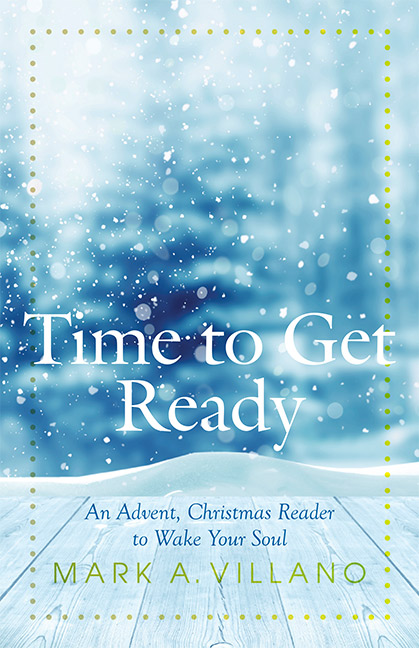
Time to Get Ready: An Advent, Christmas Reader to Wake Your Soul by Mark Villano

Advent is almost here so it is definitely Time to Get Ready for Advent and ultimately Christmas. There are many Advent devotionals available but I think this one stands out among them. It is steeped in scripture and include many quotes and stories to help the reader get more out of their spiritual life during this time of year. I liked that the readings are included at the beginning of each chapter. There is a description that unpacks the biblical message then a scriptural response. At the end of each chapter there is a summary statement that packs a punch.
We are introduced the idea of chronos and kairos to measure time. Chronos is linear time and Kairos is God's time. But we are not just passively waiting but we are called to action. We are called to bring ourself as gift to others during this season of preparation. When the author speaks "God does not want to fit comfortably into our schedule. God wants to be a living presence in our lives, fire in our hearts." This is evidence of God's call  in our lives to minister to others. First we have to find our true selves "Come to know yourself better and you will be able to know others better as well. Be happy with who you are and who you aren’t. You will see more clearly the One who gave you your true self."
From the beginning of advent to the epiphany, Time to Get ready will keep you engaged. For instance with quotes like this "An epiphany is defined as a manifestation of Christ. Franciscan author Richard Rohr, in Everything Belongs, gives his own twist to that definition: an epiphany is a place where God is both hidden and revealed. Perfectly hidden and perfectly revealed — like the manger or the cross. Not everyone is looking for those epiphanies, not everyone sees. But those who do will “ gather together.” Their journeys converge in Bethlehem. Their hearts “thrill and rejoice.”
I would recommend this book to you for inspiration during your Advent and Christmas season. The format is easy to follow. The author's voice is conversational and punctuated with scripture throughout the book. Time to Get Ready will help you make the most of your waiting for the Incarnation when God is with us in history, mystery and majesty.

Sunday, November 8, 2015

The Ragamuffin Gospel by Brennan Manning


This is the 25th anniversary of The Ragamuffin Gospel written by a former Franciscan priest. It is a beautiful exposition on God's grace. It is to the point and in your face in a good way. It wakes you up to the reality of God's love for you. Definitely a "come as you are" love freely given and not earned or deserved is at the core of the book's message. The Ragamuffin Gospel was very controversial when it was originally written in 1990 because it was not about a restrictive love based on sin and judgement. The author left the priesthood to get married and he is not shy in laying out his own faults of alcoholism for instance. The back cover says it nicely that we don't need spiritual cosmetics to make ourselves presentable to God. Ultimately that God IS Love is spelled out chapter after chapter in addition to the whimsical titles of each chapter.
One of my favorite quotes from The Ragamuffin Gospel is "Counterfeit Grace is as commonplace as fake furs, phony antiques, paste jewelry and sawdust hot dogs. The temptation of the age is to look good without being good.....The dichotomy between what we say and what we do is so pervasive in the church and in society that we actually come to believe our illusions and rationalizations and clutch them to our hearts like favorite teddy bears." I think this book is about "keeping it real" and being genuine even as we evangelize in sincerity to others. "To evangelize a person is to say to him or her , 'You are loved by God in the Lord Jesus'. And not only to say it but to really think it and relate it to the man or woman so they can sense it."
The author, Mr Manning, has written more that 20 books, and was a gifted speaker. He was a Korean war veteran and as I mentioned before a Franciscan priest. His final book was his memoir titled All is Grace. He died in 2013. There is a preface and afterward in this book written by people who knew that author personally that is specific to this 25th anniversary special edition. This helps the readers get to know the man and the author better.
I would definitely recommend this book to you. You will not be disappointed. There are multiple examples and quotes in each chapter. The voice of the author is highly relatable. The reader will discover that we are all Ragamuffins and that we are all loveable. What better message could there be and what more could you want from a book. Love and spirituality are central to the book as perhaps they should be in our own lives.

Tuesday, October 27, 2015

We'll Never Tell Them by Fiorella de Maria

A masterful story from beginning to end, We'll Never Tell Them has many layers and stories within stories. Our two main characters are Kristjana and Leo, who are kindred spirits separated by years and history. The background is World War I and World War II for the story told by Leo about his mother Liljana. Liljana has had a very hard life growing up in Malta with an abusive mother with mental illness and moving to England where she finds her first family through her friend Emily. She meets the love her life as a nurse during WWI.
Kristjana is a nurse who has run away from her life in England back to Jerusalem where she interned during college. Her life parallels Liljana's in that she is also from Malta and moved to England. Leo is her patient dying of cancer and wanting to pass on the history of his family through storytelling. Kristjana is learning about herself and her life through Leo's story of his mother, Liljana.
We'll Never Tell  is written from the point of view of the Kristjana character. She matures and decides what direction to take her life. The overarching story is about love and loss as seen through World Wars I and II. This points to what is important in our humanity and dignity. There is strong family themes of what makes a close family and what keeps us apart. James Hampton stands out as a constant character throughout Liljana's story. He is a lawyer that Liljana meets as a child and has a reoccurring role and plays a significant unexpected part in Liljana's life.  The descriptions really transport you to a different time and the reader easily becomes invested in the story of Liljana. The story is tragic and involves some adult topics but nothing is explicit. The modern day character of Kristjana is a little harder to identify with for me but I am still interested in what will happen with her as you follow her thoughts and struggles in modern day. There is a sense of hope at the end and this book that makes you want to know about the history of war torn England.
I would recommend this book to you as a fictional story that will keep you reading to the end. Fiorella de Maria, the author, is a winner of the National Book Prize of Malta for her previous book The Cassandra Curse. She was born in Italy of Maltese parents and this gives the story authenticity. In this story of We'll Never Tell Them there is a connection between Kristjana and Liljana and perhaps even between Liljana and the reader. I will not spoil the ending but let you discover it.

Tuesday, October 20, 2015

Broken Gods: Hope Healing, and the Seven Longings of the Human Heart by Gregory K. Popcak, PhD

Don't let the title fool you, because it sounds almost blasphemous, but the author is speaking of gods, small g. The author, Dr. Popcak wants to help us be our best selves but not just in a superficial way of self help but in a deep soulful way of spirituality. I was skeptical at first upon introduction, although you can not argue with St Thomas Aquinas "The only begotten Son of God, wanting to make us sharers in his divinity, assumed our nature, so that he, made man, might make men gods" Chapter two is where we start to understand about the seven longings of the human heart and how these align with the seven deadly sins, and the seven heavenly virtues. First it important to understand how the brain is most open to change when the mind experiences four qualities represented by COAL or curiosity, openness, acceptance and love.
By chapter four we have the format set for the rest of the book which is a desciption of the longing of the heart, how the deadly sins keep us from it and how specific virtues can help us counter this tendency and reach our hearts desire. Dr. Popcak is a counselor and it is evident in his approach to spirituality. I liked the format and thought the prompts at the end of each chapter would be helpful to revisit when you need support in a particular area of longings of the heart or to avoid a certain deadly sin.
I would recommend this book to you because I felt like I learned a lot. For instance being overzealous about your health and diet can also be the sin of gluttony or thinking you can attain salvation through the body. Broken Gods may be a little technical for some readers and steeped in pyschological terms but definitely a good read. This book is comforting in how it helps you to see your barriers to spiritual fulfillment and how to address them one at a time.

Thursday, October 8, 2015

The Abbey: A Story of Discovery by Father James Martin, SJ

Finding good Catholic fiction is sometimes hard. Look no further, Father Martin has hit the mark with his new book The Abbey. There are characters in this fiction story that we care about due to Father Martin's power of description and his insight into their minds and hearts. There is Anne, who has lost her son 3 years ago at just 13 years of age. Her heart ache is palpable and you can relate to her loss. She rents a home to Mark who is a handyman carpenter at the local monastery and their interaction brings her face to face with the Abbot, Father Paul. The Abbey of Philip and James is a part of her memories of her parents, herself as a child, and ultimately how she sees God and religion. Through her experiences at the abbey with iconographic Marian art and heart to heart conversations with Father Paul you experience her spiritual journey. There are sessions of spiritual direction with Father Paul even though Anne does not recognize them as such and she doesn't know why she is drawn back there time and time again. Each of the characters grow spiritually on their journey throughout the story with their relationships that develop between them.
The book is more about asking the right questions than it is about finding the answers. The characters are changed at the end but it is open ended enough for us to fill in the end for ourselves. Anne wants to know how to talk to God and how to know when God is speaking to her. Perhaps we have all had these questions at one point or the other. The dialogue is beautiful between Anne and Father Paul. The conversations between Anne and Mark seem purposefully clumsy and so appropriate for their thoughts that are going through their heads. I loved the quote from Thomas Merton "“The first and most elementary test of one’s call to the religious life—whether as a Jesuit, Franciscan, Cistercian, or Carthusian—is the willingness to accept life in a community in which everybody is more or less imperfect.” Father Paul is honest about religious life and the challenges and joys of living in community. But being a Secular Franciscan myself made me appreciate this quote from the book "But people on the outside faced pressures that sometimes made it harder to remember God. For one thing, there were the constraints of time. That’s why Paul believed mothers and fathers and doctors and lawyers and teachers and janitors—at least many of them—were holier than monks. They had to make room for God in a world that often crowded out God.
I would definitely recommend this book to you. You definitely won't be sorry. The story is realistic and hopeful. To be Father Martin's first novel it is promising and definitely delivers what it promises in the subtitle: A Story of Discovery.

Sunday, October 4, 2015

New Testament Basics for Catholics by John Bergsma


After reading this book, I want to read the previous book by Dr. Bergsma called Bible Basics for Catholics: A new Picture of Salvation History. But don't worry if you have not read it yet because the first chapter in this book gives you a quick summary of the Old Testament. One of the things that appealed to me about reading this book is an interest in understanding the overarching story of salvation history and more specifically the history of the Church founded by Christ and told in the new testament. I love the organization of the book. It simplifies the whole of the new testament by revealing the differences and similarities of the Gospels and Paul's letters. You will find shortcuts and  suggestions to help you remember important points of the bible and chronological timeline. But there is also an indepth analysis of the books of Matthew, Luke, John, Acts, Hebrews and Revelation. Dr. Bergsma states "Every sacrament is rooted in Jesus’ death and resurrection. Baptism is a sharing in Jesus’ dying and rising . In Matrimony we give our body to our spouse as Jesus gave his body on the Cross. The Eucharist makes present once more the sacrifice of Christ’s crucified body . And we could go on."
It is a big help in bible study to understand the audience the author of the original bible books  intended and the Greek meaning of words unpacked for the reader. But, I also think in Testament Basics the author speaks in common language we can all understand. You can read it like a novel straight through and keep it close by when studying the new testament. There is also enough catholic theology that helps in understanding the church's perspective as well. Bergsma states "We should call them “the books we read when we celebrate the New Testament,” or “the books that tell us about the New Testament,” because that’s what they really are. The New Testament itself is the Eucharist . To read the New Testament books without going to Mass is like looking at a menu without ever eating the meal, or reading about swimming without ever jumping in the pool. The Bible says the “new testament” is the Eucharist."
Dr. Bergsma is an associate professor of theology at the Franciscan University of Steubenville Ohio. He is a Catholic convert as of 2001 and a Catholic Biblical Scholar and Theologian. He earned his PhD in Scripture from Notre Dame. I would definitely recommend this book to you. It was a pleasant surprise to find humor and ease of reading. I was prepared for a more professorial dry read but Basic Testament is very readable, easy to understand but gives the more experienced bible student a vast insight into scripture.

Thursday, September 24, 2015

Eve by William Paul Young

From the Author of The Shack comes a new novel, Eve. This work of fiction takes on the story of creation like the Shack took on the topic of death. There is a science fiction atmosphere of the story of Eve. The story opens with John in the Refuge, a place between worlds, where a large storage container washes ashore with multiple dead bodies and one survivor. The main character is a 15 year old girl named Lilly Fields. She is paralyzed initially and has amnesia. She is in and out of consciousness while her body is being repaired but what sounds like aliens. She is told she is to be a witness of beginnings, presumably the creation story, a real Adam and Eve story. The author has some wild ideas about God as seen through an old woman Eve and a young woman Eve, an Eternal Man, Adonai, amd Elohim. Mr. Young appears sincere in his use of the main character Lilly searching for God and God's love. I think the nod to the biblical story of Lillith gets lost. I thought from the description before reading this book that Eve would be the one to wash up on the shore. Lilly has the DNA of everyone on earth but its not clear as to the significance of this fact.
I thought the descriptions were sophomoric and juvenile. True to form, Mr. Young goes very dark in his main character when she realizes that she is a rape survivor when her memory comes back. Simon enters the story and says he is her only friend and the 3 other people including John that claim to be her friend are lying and using her for their own gain. Lilly does not know who to believe. As to the creation story it certainly does not follow any of the biblical accounts, so be warned, if as a Christian you are reading this book as a scripture lover. The discrepancy is gaping and some might find it offensive.
When addressing original sin we hear “It happens when humans turn from face-to-face trust and let the darkness of death enter them. Thanks to Adam, we all have inherited shadow-sickness in our mortality. Resisting it is the war in which we are all engaged.” "Then when addressing free will “Trust is not a once-in-a-lifetime decision, but a choice made within each moment as the river runs. We are thankful for the gifts that surround us, and then we let them go, trusting that nothing will be lost, even if we lose it for a time.”
I would not recommend this book to you. It was confusing when I think the aim was to be mysterious. It misses the mark for enriching our spirituality as readers. It asserts to be of deep thought but only reinforces that God loves us. I found it simplistic and worth missing all together.

Saturday, September 12, 2015

In God's Holy Light: Wisdom from the Desert Monastics by Joan Chisttister


Meet the Desert Monastics face to face or should I say heart to heart. I loved this book for the spiritual wisdom that it imparts. I learned so much about what is important in life. It's like having a spiritual director in your pocket. I realy liked the quotes from the desert fathers that were at the beginning of each chapter. Then the rest of the chapter unpacks the meaning of the quote and expands on the explanation of how this applies to each of us in modern times.
There are 35 chapters that are short and digestible but the reader might want to give time to meditate on each. This book would be good as a Lenten retreat. The first few chapters discuss what you might want to be leary of in a false spirituality. The middle chapters describe what an adult spirituality might look like. The last chapters concentrate on an individual's place in the bigger Christian world.
One of the most interesting ideas of consulting the desert monastics is that what they dealt with in their society in Egypt in the 3rd through the 6th centuries in trying to not get caught up in the materialism and selfishness in their cities is common now for our time as well. So how do we become like the monks and nuns of their time in our modern day society? We are generally seeking a closer relationship with Christ as modern day Christians but so much is distraction and gets in our way.
The abbas advice and stories are about how to simplify our lives and get to the heart of the matter and capture our inner heart strings too. I was intimidated about the topic of the desert monastics at first but the author has made them fun and easy to understand at first read but with enough depth in spirituality to interest the seasoned reader of Christian spirituality.
I would recommend this book to you as a book to savor. It is definitely one I will keep close on my shelf and you will want to have a copy too.

Thursday, September 10, 2015

The Complete Francis of Assisi: His Life, The Complete Writings and The Little Flowers by Jon Sweeney

This a first for me, a review of three books in one. I love the title becasue it gives you a preview of the three titles that Sweeney has included under one cover. The first book is "The Road to Assissi: The Essential Biography of St. Francis" by Paul Sabatier. This is the first biography I ever read about St. Francis which was given to me by a friend and I reread it for this review. The second book is "The Essential Writings of St. Francis", here you can read the actual sayings and letters of St. Francis. The third book is "The Little Flowers" by Brother Ugolino which is a book about the legends and myths of St. Francis. I find this approach of including these three books to be a very inclusive approach to give the reader a comprehensive look at who was St. Francis. Let's now take a closer look at each of these books.
The Road to Assisi to was first published in France in 1893 by French Prostentant Paul Sabbatier. More than 45 editions have been published in French alone. So it is definitely a classic. This book gives you specific historical facts with dates needed in a good biography, but there is also a reasonable flow of interesting stories. This makes this book informative and entertaining. It starts with his early life raised an aristocrat as a Bernadone in Assisi, Italy. It goes through his meeting with the Sultan, his later life receiving the stigmata and his death including his writing the Canticle of the Sun.
The Essential Writings of St Francis edited by Sweeney, the author of this compilation, give us insights into the thoughts and mind of St. Francis. He was not a scholarly man and was a man of few words. Some of his best loved writings are letters.
The Little Flowers ia a best loved Christian favorite that many have quoted from and it includes amusing anecdotes. It is interesting to hear stories that apear to have been told by his closest followers and brothers.
This is an important look at St. Francis as a whole. Sweeney has included personal comments all the way through the book. The author seems to be a modern day expert on St.Francis including this book and many others.
I would recommend this book to you but it is a rather long read taken as a whole. One thing I think that could be made more clear is the spirituality of St. Francis. I don't think this was the aim of this particular compilation but it is more of a get to know the man and his legacy book. The book gives you a thorough introduction but only an introduction that skims the surface of the impact St. Francis has made and the depts of his spirituality.

Monday, September 7, 2015

The Man Who Wasn't There: Investigations into the Strange New Science of the Self by Anil Ananthaswamy

This isn't a catholic book and some might argue not even a religious book at all, but it has meant alot to me spiritually. It is all about our sense of self and I have found this not only to be about neurobiology and psychology but our intangible spirit. Our perceptions and thoughts that make up our sentient being and our body together make up who we are. This book has been a big piece of my recent spiritual journey. In a more conventional sense, we all know someone who has Alzheimer's, Autism, or schizophrenia, and this book helps to understand their unique perspective of themselves and the world.
I have a medical background so I am fascinated with the anatomy and physiology of our brain. I was surprised at how much we really know about the brain in the diseases mentioned above. The descriptions are easy to understand and if I am a loved one of someone with these conditions this book would definitely help me. My favorite part is the delving into our sense of self, our sense of self as subject or our "I" narrative, also our sense of self as object or "this is my body". Understanding ourselves is important before we can pursue a relationship with God or with our fellow neighbors we seek to help.
Most interesting is the descriptions of ecstatic seizures that are described as like mystical experiences of God and out of body experiences or OBEs being explained away. I don't think these physical descriptions point to atheism but that the hand of God works through our physical world. If you love science, psychology, medicine and spirituality, then this book has it all. Each condition has a detailed case study that makes the point more directly with an entertaining slant.
I would recommend this book to you but it is a bit technical in its language so be warned. It may not be for everybody. The science is sometimes hard to follow but the personal stories make up for it. I heard an interview of the author on NPR radio and was immediately intrigued. I'm glad I got to read this book for review and you definitely will not be sorry for your time spent checking out this book

Monday, August 3, 2015

Sacred Reading: The 2016 Guide to Daily Prayer by the Apostleship of Prayer

I have been pursuing a better understanding of Lectio Divina. This ancient spiritual practice seems simple but yet complex and hard to begin. I love Sacred Reading because it takes you by the hand and walks you through the process. The steps are 1) Knowing that God is present, 2) Read the Gospel reading for the day, 3) Notice what you think or feel, 4) Pray as you are led, 5) Listen to Jesus, and 6) Ask God to show you how to live today. Starting with Advent 2015, the beginning of the Catholic Church year, the gospel readings are included for each day following the church year calendar. The Saints for each day are included as well. The Apostleship of Prayer is an international Jesuit prayer ministry. They have a popular website Apostleshipof Prayer.org. Their organization has put together this different type of prayer book. Just as important as the content is what is not written within the pages, your prayers, thoughts and hopes. What we bring to the book, the more we can reap from the instruction in Lectio Divina. I truly believe that after using this book for a year, I will have evolved in my knowledge and practice of this ancient prayer practice. The other benefit is helping the reader tap into the life of the Church and the liturgical seasons. I definitely recommend this book to you. I am looking forward to rereading and using Sacred Reading in my prayer life in the next church year. This book has helped me to grow closer to God’s word and enriched my prayer life and relationship of faith. If you ready to go beyond basic bible study and are ready to pray with the bible, then this book is for you. Living the bible and incorporating God’s word into your daily life is within reach using these pages as teacher and guide.